
If you are asking how much does a new roof cost, the fastest honest answer is this: in the U.S., most homeowners should expect a typical range of about $5,871 to $13,228, with a broader national average around $9,500, while large or premium projects can climb well beyond that and may exceed $46,000. The final number depends on roof size, material, pitch, labor rates, tear-off work, permits, and whether hidden damage shows up once the old roof comes off.
That is why two neighbors with homes that look similar can receive very different quotes. One may need only standard asphalt shingles on a simple roof. Another may need decking repairs, upgraded flashing, and a steeper installation with harder access. This guide breaks the price down in simple words so you can budget more accurately and compare estimates with confidence.
Table of Contents
- Quick Answer: How Much Does a New Roof Cost in 2026?
- Average New Roof Cost by Home Size
- 1,000 sq ft roof
- 1,500 sq ft roof
- 2,000 sq ft roof
- 2,500+ sq ft roof
- New Roof Cost Per Square Foot and Per Roofing Square
- What is a roofing square?
- Why is the roof area not the same as house size
- Cost of a New Roof by Material
- Asphalt shingle roof cost
- Metal roofing cost
- Flat roof replacement cost
- Tile and slate roof costs
- Wood shingle / shake roof cost
- What Affects the Cost of a New Roof?
- Labor cost
- Tear-off and disposal
- Roof pitch and complexity
- Decking, flashing, and underlayment
- Permits, inspections, and code upgrades
- Location and season
- Roof Repair vs. Roof Replacement: Which Makes More Financial Sense?
- Metal Roof vs. Shingles: Is the Higher Upfront Cost Worth It?
- How to Estimate Your New Roof Cost Step by Step
- Measure roof size
- Pick a material
- Add labor and removal
- Add hidden costs
- What Should Be Included in a Roofing Quote?
- Materials
- Labor
- Tear-off
- Decking repairs
- Flashing / ventilation / cleanup / warranty
- How to Compare Roofing Quotes Without Overpaying
- FAQs
- How much does it cost to replace a roof on a 1,500-square-foot house?
- How much is a new roof on a 2,000-square-foot house?
- What is the cheapest roofing material?
- How much does roofing labor cost per square?
- Does homeowners insurance cover a new roof?
- Is it cheaper to repair or replace a roof?
- How long does a new roof last?
- How long does roof replacement take?
- Conclusion
Quick Answer: How Much Does a New Roof Cost in 2026?
For a standard U.S. residential roof, a new roof usually costs about $4 to $11 per square foot using common materials. On that basis, a 1,500-square-foot roof often lands around $6,000 to $16,500, while a 2,000-square-foot roof often falls around $8,000 to $22,000. Those are useful planning numbers, but they are still only starting points.
A better way to think about roofing cost is this: the base price comes from size, material, and labor; then the real-world extras get added on. Those extras often include old-roof removal, dumpster and disposal costs, permit fees, flashing, underlayment, ventilation work, and any rotten decking that needs replacement.
Average New Roof Cost by Home Size
Using recent U.S. estimates, these are reasonable ballpark examples for common roof sizes. Your roof surface may be larger than your home’s floor area, especially if the roof is steep or has multiple sections.
| Roof size | Typical cost range |
| 1,000 sq. ft. | $4,000 to $11,000 |
| 1,500 sq. ft. | $6,000 to $16,500 |
| 2,000 sq. ft. | $8,000 to $22,000 |
| 2,500 sq. ft. | $10,000 to $27,500 |
| 3,000 sq. ft. | $12,000 to $33,000 |
These examples are useful because they answer the question most homeowners really mean: “What would this cost on a house my size?” But remember that a simple 2,000-square-foot asphalt roof and a complex 2,000-square-foot metal or slate roof are not remotely the same project.
1,000 sq ft roof
At this size, a straightforward asphalt shingle project may stay near the low end of the range. But once you add steep pitch, difficult access, skylights, or decking repairs, the price moves quickly.
1,500 sq ft roof
This is where many homeowners start seeing quotes that vary widely. One contractor may quote a clean replacement with limited extras, while another includes disposal, upgraded underlayment, flashing details, and warranty coverage in the same number. That is why comparing line items matters as much as comparing totals.
2,000 sq ft roof
A 2,000-square-foot roof is a useful benchmark because it sits near the middle of many homeowner searches for average roof replacement cost. On a standard residential project, it often becomes the clearest example of how material choice changes the budget. Asphalt may remain manageable, while metal, tile, or slate can push the project much higher.
2,500+ sq ft roof
Once you move above 2,500 square feet, price increases are not just about area. Bigger roofs also tend to bring more roof planes, more valleys, more flashing points, and more labor hours, which is why roofing cost usually rises faster than homeowners expect.
New Roof Cost Per Square Foot and Per Roofing Square
Roofers often price jobs using square feet and roofing squares. One roofing square equals 100 square feet. That unit helps contractors estimate shingles, underlayment, and other materials more efficiently.
What is a roofing square?
A roofing square is simply a 10-by-10-foot area of roof, or 100 square feet. If your roofer says your home needs 20 squares, that means the roof surface is roughly 2,000 square feet before waste factors and complexity are added.
Why is the roof area not the same as house size
This is one of the biggest points homeowners miss. Your house might have 2,000 square feet of living space, but your roof area can be larger because of slope, overhangs, dormers, hips, valleys, and attached structures. In other words, new roof cost per square foot depends on the roof itself, not just your interior square footage.
A simple example makes this easier: two homes can both be 2,000 square feet inside, but the home with a steeper roof, more sections, and more penetrations will usually cost more to replace because it uses more material and more labor time.
Cost of a New Roof by Material
For homeowners building new or upgrading old materials, professional roof installation helps ensure the roofing system is installed correctly from the start. Material choice is one of the biggest reasons roof estimates swing so much. Recent U.S. pricing guides show the following installed cost ranges as useful planning benchmarks.
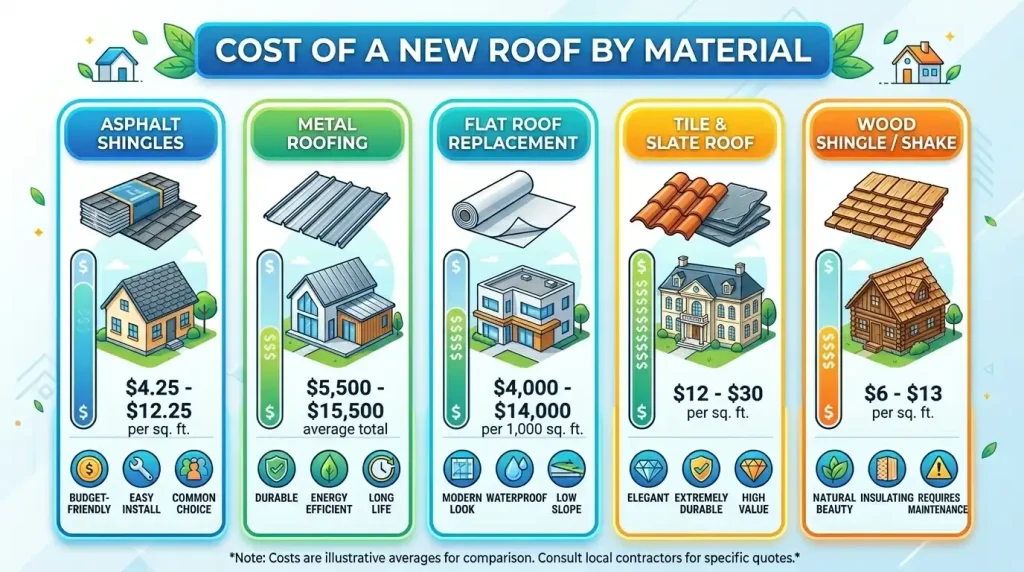
| Material | Typical installed cost |
| Asphalt shingles | $4.25 to $12.25 per sq. ft. |
| Metal roofing | $5,500 to $15,500 average total, or roughly $4 to $30 per sq. ft. depending on system |
| Flat roof systems | Roughly $4,000 to $14,000 for 1,000 sq. ft.; average around $7,421 |
| Clay tile | $12 to $25 per sq. ft. |
| Slate | $12 to $30 per sq. ft. |
| Wood shingles/shakes | $6 to $13 per sq. ft. |
Asphalt shingle roof cost
Asphalt shingles are usually the most practical choice for homeowners who want the lowest upfront cost. Installed shingle pricing commonly falls around $4.25 to $12.25 per square foot, and separate comparison guidance from NerdWallet places asphalt systems broadly around $1.50 to $6 per square foot depending on scope and assumptions. In plain terms, asphalt is usually the budget-friendly route, but the lifespan is shorter than metal, tile, or slate.
Metal roofing cost
Metal roofs cost more upfront, but they are often chosen for durability, lower maintenance, and longer life. Recent estimates put the average total metal roof cost at $5,500 to $15,500, with many projects coming in just under $10,500. In side-by-side comparisons, metal is generally more expensive than asphalt, but it can last much longer and may improve energy performance in the right climate.
Flat roof replacement cost
Flat roofs follow different pricing logic because the materials and installation methods are different. Angi’s 2026 data puts the average flat roof replacement cost at $7,421, with a broad range from $1,200 to $24,000, and examples of $4,000 to $14,000 for a 1,000-square-foot flat roof. This is why flat roof jobs deserve their own estimate rather than being lumped into general sloped-roof averages.
Tile and slate roof costs
Tile and slate sit at the premium end of the market. Clay tile commonly runs around $12 to $25 per square foot, while slate can reach $12 to $30 per square foot. These materials can last a very long time, but they come with higher upfront costs and may require stronger structural support because of the added weight.
Wood shingle / shake roof cost
Wood shingles and shakes usually sit in the middle-to-upper range at roughly $6 to $13 per square foot installed. They can look great on the right home, but they generally need more maintenance than asphalt or metal and may be less practical in areas with moisture, fire risk, or strict code requirements.
What Affects the Cost of a New Roof?
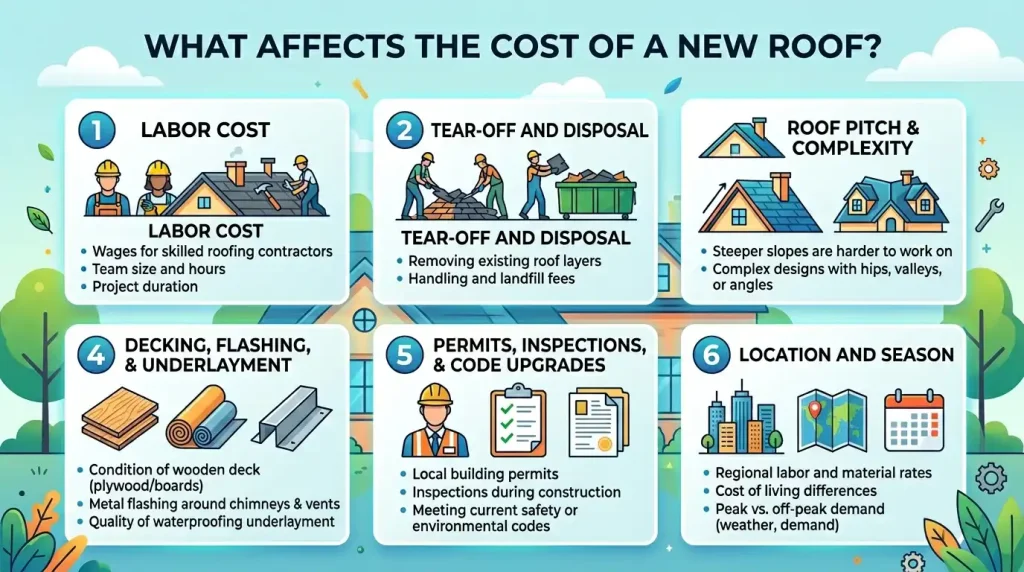
In places like Temecula, California, roof pricing can also be influenced by local weather exposure, sun damage, the condition of existing roofing materials, and the urgency of the project. Homes dealing with cracked tiles, worn shingles, or active leaks may need repairs before a full replacement begins. That is why many homeowners start with a professional roof inspection to understand whether they need a full new roof, targeted roof repair, or leak repair first. If you want a realistic new roof cost estimate, do not focus on material alone. These are the factors that most often move the number.
Labor cost
Labor is a major share of roofing costs. In NerdWallet’s metal-versus-asphalt comparison, labor accounts for about 60% of shingle roof cost and about 60% of metal roof cost as well, while another NerdWallet metal guide notes labor can make up as much as two-thirds of a metal roofing project. That is why cheap quotes often hide labor shortcuts.
Tear-off and disposal
Removing old shingles, hauling debris, and using a dumpster all add to the total. Some estimates include these costs clearly; others bury them. If the contractor must strip the roof to bare decking, cleanup and disposal should be listed in the estimate.
Roof pitch and complexity
Steeper roofs cost more because they need more safety precautions, more time, and sometimes special equipment. Complex roofs with multiple valleys, dormers, skylights, and penetrations also take longer to install and flash correctly.
Decking, flashing, and underlayment
This is where many budgets get blown. If the decking under your shingles is soft, rotten, or mold-damaged, it may need replacement. NerdWallet notes decking repairs can add roughly $2 to $5 per square foot of decking replaced on both metal and asphalt projects.
Permits, inspections, and code upgrades
Permits vary by location. NerdWallet notes shingle permits can run roughly $50 to $300, while metal roof permits may run $250 to $500 where required. Angi also advises homeowners to account for permit fees, inspections, and warranty coverage when budgeting.
Location and season
Roof prices are not uniform across the country. Labor, material delivery, local codes, and cost of living all matter. Seasonal timing matters too: Angi notes some repair work can cost significantly more in winter conditions, while slower seasons may bring discounts in some markets.
Roof Repair vs. Roof Replacement: Which Makes More Financial Sense?
If the problem is small and localized, roof repair service is usually the smarter move. Angi’s 2026 data puts average roof repair costs around $394 to $1,944, while full replacement sits far higher. That gap is large enough that many homeowners should repair first when the roof still has life left in it.
Roof replacement starts making more sense when the roof is near the end of its lifespan, when repairs keep coming back, or when the damaged area is widespread. Angi specifically notes that a full replacement deserves strong consideration if the roof is about 20 years old or more or if an inspection shows more than 20% damage.
A simple rule helps here. Repair when the issue is isolated. Replace when the roof is old, the damage is broad, or the repairs are starting to feel like repeated temporary patches. That is the point where the cost to replace the roof becomes cheaper in the long run than paying for ongoing roof leak repair, emergency fixes, and interior damage.
Metal Roof vs. Shingles: Is the Higher Upfront Cost Worth It?
For many homeowners, this is the real buying decision. Asphalt shingles usually win on upfront price. Metal usually wins on lifespan, durability, and lower maintenance. NerdWallet’s comparison guide places metal broadly at $4 to $30 per square foot with a lifespan of 40 to 80 years, versus asphalt at $1.50 to $6 per square foot with a lifespan of 20 to 30 years.
So is metal worth it? It can be, but only if the longer life, storm resistance, maintenance profile, and energy performance matter in your situation. If you plan to stay in the home for a long time, metal may be easier to justify. If budget is tight or you expect to move sooner, asphalt often delivers the better short-term value. JLC’s 2024 Cost vs. Value data also shows roofing projects can return meaningful resale value, though not full cost recovery, and asphalt shingle replacements retained more value than metal in the national averages shown there.
How to Estimate Your New Roof Cost Step by Step
Measure roof size
Start by estimating roof surface area, not just house size. If you are unsure, use your home’s footprint as a rough starting point, then add for slope, overhangs, and complexity. For roofing math, remember that 1 square = 100 square feet.
Pick a material
Next, choose the material family: asphalt, metal, flat membrane, wood, tile, or slate. This single choice may move your budget more than anything else. A homeowner choosing between asphalt and metal is not comparing a small upgrade; they are often comparing a fundamentally different cost structure and lifespan.
Add labor and removal
Then add installation labor, tear-off, disposal, and site cleanup. Do not assume those are already included. One reason homeowners end up over budget is that the initial “material quote” sounded low, but the full installed price was much higher.
Add hidden costs
Finally, budget for the things that show up after work begins: bad decking, flashing replacement, permit fees, ventilation updates, and code-driven changes. This is also where homeowners should leave room for contingency money rather than spending to the last dollar.
What Should Be Included in a Roofing Quote?
A roofing estimate should be detailed enough that you can compare it line by line.
Materials
The quote should list the exact roofing system, not just “new roof.” That includes shingles or panels, underlayment, starter materials, ridge caps, flashing, vents, and any manufacturer-specific components.
Labor
Labor should be included clearly, whether priced as part of the project or separated out. If labor seems unusually low, that is a red flag. Roofing is labor-heavy work, and underpricing often means corners get cut somewhere.
Tear-off
Ask whether old roofing removal is included. A quote that leaves out tear-off and disposal can look cheaper than it really is.
Decking repairs
This should be handled in one of two ways: either the quote includes an allowance for damaged decking, or it clearly states the unit price if decking replacement becomes necessary. Without that clause, surprise costs are much more likely.
Flashing / ventilation / cleanup / warranty
These details separate a serious estimate from a weak one. Flashing and ventilation mistakes are common causes of future leaks, while cleanup and warranty terms affect your total value, not just your price. Angi specifically recommends budgeting for warranty coverage, and IKO emphasizes reaching out to qualified contractors when making these decisions.
How to Compare Roofing Quotes Without Overpaying
Do not choose based on total price alone. First, make sure every quote covers the same scope. One roofer may include tear-off, upgraded underlayment, warranty coverage, and cleanup, while another leaves half of that out. The lower quote is not always the cheaper project.
Second, get at least three quotes. Angi recommends doing exactly that on repair projects, and the same logic applies to replacement work. Multiple quotes help you spot unrealistic numbers, vague scopes, and sales-heavy upsells.
Third, ask each contractor the same practical questions:
- What material are you quoting?
- What is included in tear-off and cleanup?
- What happens if bad decking is found?
- How long is labor covered?
- Will permits be handled for me?
Those answers matter more than polished sales talk. A trustworthy roofing quote is specific, readable, and easy to compare. That is what makes decision-making easier for the homeowner.
FAQs
How much does it cost to replace a roof on a 1,500-square-foot house?
A useful planning range is about $6,000 to $16,500, but the actual cost depends on material, complexity, and local labor. Asphalt usually sits lower than metal, tile, or slate.
How much is a new roof on a 2,000-square-foot house?
For many U.S. homes, a 2,000-square-foot roof falls around $8,000 to $22,000 using common materials. Complex designs or premium systems can go much higher.
What is the cheapest roofing material?
Asphalt shingles are usually the lowest-cost mainstream option for residential homes. They are widely available, easier to install than many alternatives, and generally cheaper upfront than metal, clay, or slate.
How much does roofing labor cost per square?
Labor varies by market and roof type, so there is no universal number. What matters is that labor is a major share of the total, often around 60% on asphalt and metal systems in NerdWallet’s comparisons.
Does homeowners insurance cover a new roof?
Sometimes. Standard homeowners insurance usually covers roof damage from covered events such as wind, hail, fire, or lightning, but not routine wear and tear, deterioration, rot, or poor workmanship. Always check your policy terms and claim rules.
Is it cheaper to repair or replace a roof?
Repair is usually cheaper when the damage is limited and the roof still has useful life left. Replacement becomes the better financial move when the roof is old, repairs are recurring, or a large part of the roof is damaged.
How long does a new roof last?
It depends on material. In the sources above, asphalt commonly falls in the 20 to 30-year range, while metal often lasts 40 to 80 years. Slate and some tile systems can last even longer.
How long does roof replacement take?
Project length depends on roof size, weather, complexity, and material. Simpler jobs may move quickly, while complex projects take longer. Flat roof work and structural repairs can also extend the schedule.
Conclusion
If you came here asking how much does a new roof cost, the smartest takeaway is this: start with the national range, but make your budget around the details that actually change the quote size, material, labor, tear-off, permits, and hidden repairs. That gives you a more realistic number than any headline average ever will.
Before you sign anything, measure your roof as accurately as you can, narrow your material choice, and compare at least three estimates line by line. That is the easiest way to avoid underpriced quotes, spot missing work, and choose a roof that fits both your home and your budget.
If you are a homeowner, getting a local inspection in Temecula before comparing estimates can help you understand whether your roof needs a simple repair, leak work, or a full replacement. Regular roof maintenance can extend roof life and reduce the chance of expensive emergency repairs. For homeowners in any U.S. market, the same rule applies: accurate inspections lead to more accurate roofing quotes.